Events that took place in Faculty of Law during the soon to be concluded second semester.
In recent weeks, the faculty of law has witnessed a lot of colourful and exciting events starting from the leadership conference organized by Solace Chambers under the administration of the past Attorney General of Solace Chambers in person of Nizam Baba. The conference was graced by many distinguished personalities who delivered powerful speech on leadership skills, maintaining academic excellence amongst others. The program was also graced by the National President of Law Students Association of Nigeria, Dr. Blessing Agbomhere who visited the faculty in order to hold a stakeholders meeting with the stakeholders in the faculty. On the same day, the Tax Club of Bayero University kano organized a lecture which was graced by many notable personalities, tax enthusiasts and students across the university.
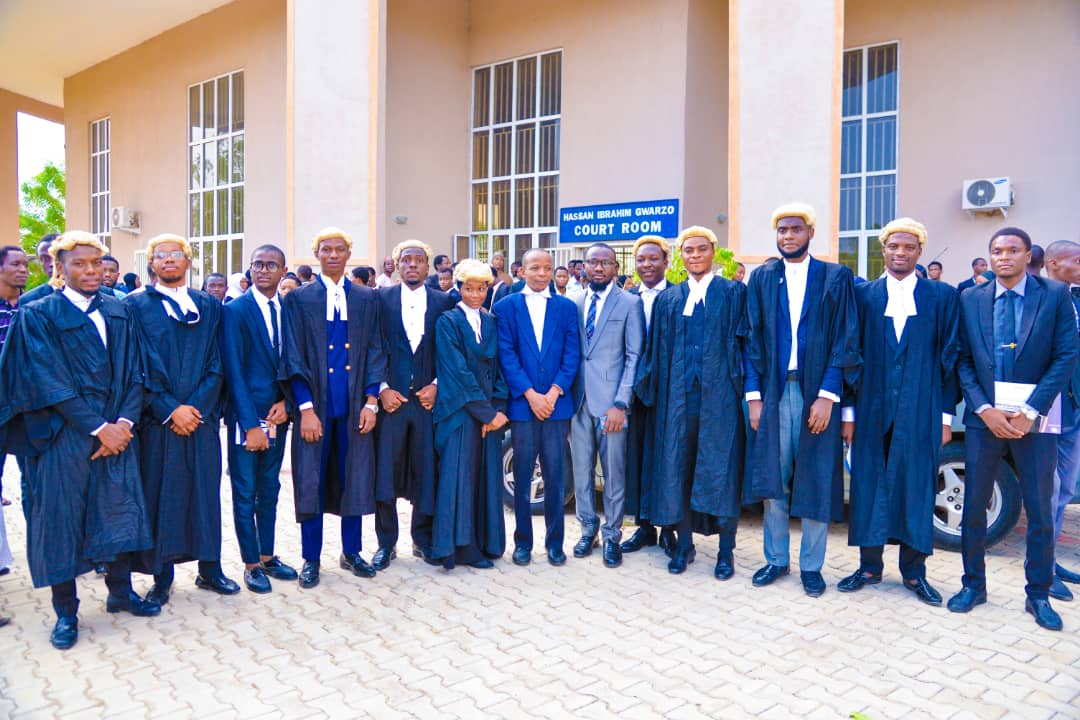
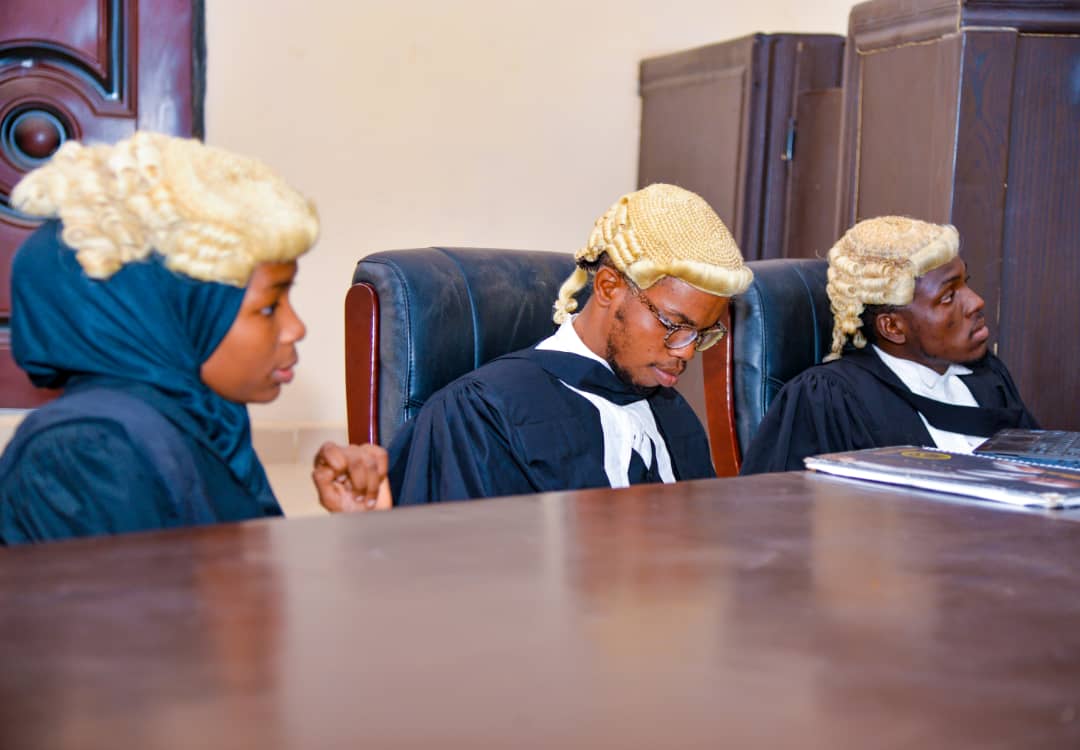
Moving on, the faculty of law hosted a moot court battle between Equity Chambers, Ahmadu Bello University Zaria and Equity Chambers, Bayero Univeristy Kano. The host of the program was Abdul Basit Shuaib popularly known as Bashlaw and the proceeedings was presided over by the Chief Justice of LAWSAN, Lord Justice Munir Ishaq alongside the Chief Justice of BUK Union Court, Salihu Saidu and Justice Sofiyullahi Balogun,the Clinic Head, ABU Law Clinic.
The Bayero University, Kano was represented by Muhamad Sadiq Yasir Abubakar, Mustapha Babalola Toheeb and Amina Faruk and ABU was represented by Ibrahim Fatika, Musa Zubair and Qoyum Biodun. Both teams performed excellently as the proceedings was interesting and educative, in the end the ABU team emerged the winner after a keenly contested moot proceedings. Furthermore, the Law Clinic organized a public lecture on the new ACJL of Kano state which was graced by various notable personalities including Saeed Suraj SAN, the Chairman, NBA Kano amongst others. The lecture which was organized under the mantle of Sulaiman Abdullahi was regarded as one of the best public lecture ever organized in the faculty. Recently, the International Law & Jurisprudence, BUK Department organized a sendforth programme for Dr. Saffiyya Ahmad Nuhu who was just appointed as Nigeria’s Ambassador to Romania. The event was graced by all the lecturers including the Dean and various professors, during the event, the Ambassador was praised for her impeccable work ethic and good nature. The faculty wished her best of luck in her future endeavours.
STUDENTS’ UNION BAR ASSOCIATION, BAYERO UNIVERSITY, KANO.
OFFICIAL ANNOUNCEMENT
This is to inform all eligible and interested student legal practitioners in the Bayero University Kano campus that the application for the rank of Senior Advocate of Bayero University Kano (SABUK) is now ongoing.
Procedure for the application:
a) Applicants are to purchase the application form at the rate of 1000 Naira payable to the secretary or president of the association;
b) The form is to be completed and submitted to the secretary or the president of the association on or before Thursday, 27th May, 2021.
Please, be informed, application closes exactly at 5:00 PM on Thursday, 27th May, 2021 .
NORTH WEST ZONAL DIRECTORATE OF PROGRAMS, POLICIES AND PROJECTS. LAW STUDENTS ASSOCIATION OF NIGERIA
The LAWSAN President, Dr. Blessing Agbomhere paid a visit to Faculty of Law, Bayero University Kano, where he had a roundtable meeting with stakeholders at Faculty of Law, BUK.
During the meeting, crucial issues including the need to participate in LAWSAN activities, the need to pay the LAWSAN Identification Number expenses amongst other crucial issues were discussed.
After the stakeholders meeting, the President, accompanied by the Chief Justice of National LAWSAN, Hon. Justice Munir Shuaibu Ishaq, COL, proceeded to a leadership training conference which was hosted by Solace Chambers, BUK Law, where he addressed students across the university on leadership skills.
The LAWSAN BUK Leadership led by Sen. Sunusi Abubakar expressed their happiness and stated that the visit is a privilege which was really appreciated.
The Directorate wishes to thank His Excellency, Dr. Blessing Agbomhere for taking such brave steps which was aimed at improving the standard of LAWSAN not just in Kano State but also in LAWSAN generally.
The Directorate wishes His Excellency, a safe journey back to his base and wishes him best of luck in his future endeavors.
God Bless North West Zone! God Bless LAWSAN! God Bless Federal Republic of Nigeria!
Signed: Mustapha Babalola Toheeb
Zonal Director, North West Zonal Directorate of Programs, Policies and Projects, LAWSAN.
Yusuf Emiola emerges as the new President, Students Union Bar, BUK.
The irrepressible and seasoned student legal practitioner, Yusuf Olalekan Emiola before his appointment has been in active practice for close to five years and has been involved in notable cases like the election petition case involving Sir Kuli Kuli, Captain Idris Ahmed Vs. Speaker, Students Representative Assembly& 1 ors (2018), where he got a judgement in favour of the Welfare Director of the Students Union Government 2017/2018 who was arbitrarily removed from office by the defendant.
In addition, he handled the case of Yusuf Emiola VS. Welfare Director, Students Union, BUK. (2017).
Apart from his court room exploits,he has been a major contributor to the development of the BUK Law Clinic over the years particularly during the STUNT project and other projects which he participated in.
Not resting on his laurels, he is a recipient of many awards such as Legal Icon of the year in 2018 and in 2019, he emerged winner STUNT Project, sponsored by Youth Alive Foundation with support from Ford Foundation.
It’s obvious that this appointment is well deserved as Mr Emiola has contributed immensely to the development of the BUK Bar.
Formation and registration of statutory marriage; who has the power between Ministry of interior and local government?
Registration of Marriage is one of the requisites that evidenced the conduction of a valid Statutory Marriage under Section 30 and 32 of the Marriage Act, before such can be registered, validly tendered and admissible in a court of competent jurisdiction ; it has to be registered and issued by an appropriate authority. What constitutes this appropriate authority has been subjected to controversies among the people on who should issue the Marriage certificates, even though, same has been given judicial notice by Federal high court. Opening to the discourse as to whether it is the Ministry of interior or the Local government council under the provisions of Marriage Act as well as the Constitution of Federal Republic of Nigeria 1999 as amended. The bone of contention of this assignment therefore, is to examine whether or not there is a conflict in the provision of Marriage Act on the registration and issuance of marriage certificate. In order to determine whether there is a conflict in the said provision however,it is pertinent to look at the power conferred on both the Ministry of interior as federal government agency and Local Government council under item 61, exclusive legislative list; second Schedule of the 1999 Constitution and item 1(i) of fourth Schedule to the Nigerian 1999 constitution as amended to register all birth, death and Marriages respectively as well as to make submission as to the validity of marriages registered by the ministry of interior and that of local government council in exercising their constitutional powers. REGISTRATION AND ISSUANCE OF MARRIAGE CERTIFICATE BY MINISTRY OF INTERIORS ; WHETHER OR NOT THERE IS A CONFLICT WITH THE PROVISION OF MARRIAGE ACT. It’s not of dispute that while the issues relating to statutory Marriages are within the exclusive legislative list under item 61, second Schedule to the 1999 Constitution ; the constitution has also conferred power on the Local government council under item 1(i) of fourth Schedule to the Nigerian 1999 constitution as amended to register all birth,death and Marriages. Also, the procedure to be taken in the registration of Statutory marriages has been provided for under section 30 (1) of the marriage Act which reads thus: ” Every registrar shall forthwith register in a book to be kept in his office for such purpose and to be called the Marriage Register Book, every certificate of the marriage which shall be filed in his office according to the Form F in the First Schedule; and every such entry shall be made in order of the date from the beginning to the end of the book, and every entry so made shall be dated on it is so entered, and shall be signed by the registrar,and such book shall be indexed in such manner as it is best suited for easy reference thereto.” Thus, the question of who can validly register statutory marriage between the ministry of interior and the Local government council is not clearly provided for under the Marriage Act as the Act under section 30 (1) only use the word “Registrar” whose office is directed by the minister under section 5 of the Marriage Act. Nonetheless, the Nigeria 1999 Constitution has clearly shown the power of the federal government in the exclusive legislative lists under item 61 to the second Schedule which provides : ” The formation ,annulment and dissolution of marriages other than marriages under Islamic Law and Customary Law including matrimonial causes relating thereto.” And that of the local government under item 1(i)which provides : ” Registration of all births, deaths and Marriages”. These controversies as to who can validly register Statutory marriages has now been given judicial notice by the Federal high court in the unreported case of HAASTRUP & ANOR v. ETI OSA LOCAL GOVERNMENT & 2 ORS (FHC/L/870/2002), where it was posited that those who can validly contract or celebrate marriages include the Ministry of Interior. However, with respect to registration of marriages, it is within the exclusive authority of the Registrar in the marriage district (Local Government) in accordance with the provisions of section 30(1) of the Marriage Act, section 7(5) Constitution of the Federal Republic of Nigeria 1999 and Paragraph 1(i) Fourth Schedule to the constitution. Also, this decision has been upheld by the court in an unreported case of EGOR LOCAL GOVERNMENT, EDO STATE & ORS Vs. HON MINISTER OF INTERIOR & ORS (FHC/L/ CS/1760/16) in this case ; the suit was filed by some local government councils in Nigeria, challenging the power of the Federal Ministry of Interior to operate marriage registries.The councils are Egor Local Government (Edo), Eti-Osa Local Government (Lagos), Owerri Municipal Local Government (Imo) and Port Harcourt City Local Government Area (Rivers).The respondents in the suit are the Federal Ministry of Interior and the Attorney-General of the Federation.The issue for determination in the case was whether it is only local government authorities that can contract and register Marriages to the exclusion of such other authorities designated by the Ministry of Interior. Consequently, the Court merely upheld and re-affirmed the position in the Haastrup’s case, that the Ministry of Interior can validly conduct marriages but reserved the power for registration of marriages exclusively in the Local Government. At this juncture, it is important to distinguished between Conduction of Marriages as well as Registration of Marriages. While the former deals with the process of forming a valid marriage contract which can be perfected by any licensed authorities, the latter comes after the marriage contract to evidenced that, marriage has been conducted between the patties which has a greater legal consequences where the due process is not followed. Moreover, The recent move made by the ministry of interior to create marriage registries to conduct and issue marriage certificate in 11 states of the federation, these states includes : Ikoyi , Lagos State ; Abuja , Federal Capital Territory ; Benin , Edo State ; Owerri , Imo State ; Port Harcourt , Rivers State ; Kano , Kano State ; Jos, Plateau State , Enugu, Enugu; Kaduna, Kaduna; Ibadan , Oyo State ; and Makurdi , Benue State claiming that the formation of statutory marriages is within the exclusive legislative list and that it was the regulatory body for the conduct of statutory marriages and the issuance of marriage certificates. The Local government on the other hand sees this development as an infringement to their constitutional power and Function under 1(i) to the fourth Schedule to the 1999 Constitution. On this note, the functions conferred on the local governments places no ban on the Ministry of Interior, licensed places of worship and other lawful authorities to contract and celebrate marriages. The court had also declared valid all marriages contracted under a licence granted by the Ministry of Internal Affairs, Director General of a state government in charge of marriages, any state ministry, or by any officer in any of the ministries. Based on the decision given in the Haastrup’s case, it only restrains the Ministry from further registration of Marriages. By implication, marriages registered at the Ministry of Interior before the decision in Egor Local Government V. Hon Minister of Interior are valid while further registrations conducted by the Ministry of Interior may be challenged. It is however pertinent to state that : even though the registration and issuance of marriages is conferred on the Local Government, such must be exercised in accordance with the provision of Marriage Act as illustrated by the court in the case of Olumide Babalola V. Ikeja Local Government and Anor ( Suit NO. LD/1343GCM/16], the Claimant applied for a declaration that the local government does not have power to issue modified/customized Marriage Certificates different from the one provided for in Form E under Section 24 of the Marriage Act and a declaration that the Registered Trustees of Association of Local Governments in Nigeria (ALGON) Unified Marriage Certificate is unconstitutional, null and void. The Court affirmed the position with regards to the form of the Marriage Certificates, it however held that marriages that are already conducted and are not in conformity with Form E be regarded as good and valid in Law for all intents and purposes, there should however, be a reissuance of the proper certificate to all persons in possession of the “invalid certificates “and this will have no effect on the subsisting validity of the Marriage. Conclusively, in light of the judicial authorities discussed above and in line with the relevant statutory provisions cited,one can validly conclude that while the local governments have the right to validly register and issue certificates of Marriages as conferred on them under item 1(i) of fourth Schedule to the Nigerian 1999 constitution as amended; so far such is comply with all the stipulated provisions in the Marriage Act, for the issuance of Form E and no other customized form is acceptable, failure to comply with the provision renders the whole process voidable ; the formation of Marriage is exclusively regulated by the Ministry of Interior under exclusive legislative lists, item 61 of the second Schedule to the constitution of Federal Republic of Nigeria, 1999 as amended. Hence, there is no conflict as regards the registration and issuance of marriage certificate, since each powers and functions of each tiers of government has been clearly defined under the constitution.
RESTORATIONS OF DENGI WARD YOUTHS amiru zubairu haruna (dan majen bunwur) was born on 2nd june 1997 at dengi municipal ward of kanam, in the famous family of Alh zubairu haruna (Dan Amarya Driver) of dengi, Dan maje attend his primary school at central primary school and mu’assasa Qur’anic school of jibwis dengi from the year 2001 to 2006, and He went to comprehensive day secondary school Dengi. He later went to college for legal and islamic studies misau where he obtained his diploma in shari,a and civil law from the year 2015-2017. During his course of study, he held various positions. He serves as Assistant class rep from primary one to five he latter become labour prefect in class six. and he held the office of utility prefect and financil secretary( mssn) CDSS Dengi. he also held the position of ICPC president (ICPC boss), ambasador to Nasarawa Plateau Student Union (NAPSU). He was a senior special advicer on security matters to the student union government president (SUG),Gombe state students union protocol (GOSSA),secretary to the Annur chamber ( LAWSAN). He was also a member of the masjid committee under the Muslim student society of Nigeria(MSSN). He was admitted in 2018 at Bayero University Kano, where is currently undergoing his LLB program. He was corronated as the first Dan majen bunwur on 26th march 2020. He is the current president of Kanam law students society(KLASS). With all this credentials listed above and also by his contributions to the community good, he has shown and displayed a sense of duty. And with his achievements, earn through unwavering respects for elders and custodians of law Within and outside Dengi Ward and kanam at large. He is dedicated and more than qualified to run for this position. Because, we consider and believe in him(Dan maje), to be a man of: man of sound intellect, a man of wisdom, a man of confidence And a man o the people.
Finally, with his experience in leadership and struggle, and his commitments to service, he will be a able to make a representation of the good people of Dengi municipal ward in the State Local Government Legislative House, as a councilor Dengi ward, in the fourth coming Local Government Electios in Plateu State. Your Contribution and support to Dan maje is of paramount important. thank you sir.
Student Lawyer drags Caretaker Committee, SUG to Union Court prays for the dissolution of the CTC.
The BUK Student Union Court resumed hearing today on the 4th day of May 2021 and it was presided over by the Chief Justice of Union Court, Justice Rilwan Salihu Saidu alongside learned Justice Muhammad Wonigi JUC and Justice Fatima Abdullahi JUC.
The cases that came up for hearing was: 1. Bara’u Saeed Zubair v. The President, Law Students Association of Nigeria, BUK & 1 Ors. (2) Tahir Balarabe Isah *and* Lawsan, BUK & 1 Ors. (3) Bakare v Caretaker Committee, SUG.
The first case that came up was Bara’u Saeed Zubair v. The President, Law Students Association of Nigeria, BUK & 1 Ors.
Mallam Yusuf Emiola and Muhammad Kumo announced appearance for the Applicant, while Muhammad Yasir Abubakar Sadiq alongside S.A Abdulmudallib, Darda Abu Darda, Abdullahi Toyin announced appearance for the Respondent.
The matter came up for continuation of hearing. A legal argument ensued as to the admissibility of a an evidence in a phone which the Applicant’s counsel, Mallam Yusuf Emiola contend that it was a computer and by the virtue of that, the provisions of the evidence Act doesn’t regulate it while the respondent counsel, Muhammad Yasir objected and informed the court that it’s a computer generated evidence and by the virtue of that the provisions of Evidence Act is applicable.
Per Wonigi JUC, told the parties to address the issues raised in their final written address.
The Plaintiff/Applicant filed their Further & Better Affidavit and adopted same.
The Court adjourned the case to the 18th day of March, 2021 for adoption of Final Written Address.
The second case that was heard was the case of Tahir Balarabe Isah *and* Lawsan, BUK & 1 Ors. Counsel for the applicant, Yusuf Akanbi announced his appearance for the claimant.
The case was for mention. The defendants were not represented after being served with the applicant’s writ. So, Mr Akanbi made application to the effect that since the case has been filed for a while now and service has been effected on defendants.
The court asked for the proof of service which was given to them by the Registrar.
After then, Mr Akanbi applied that the court give the applicant hearing date so as to commence the case proper since the defendants have been served.
So the application was granted and the case adjourned till 18th May 2021 for hearing.
The last matter to be heard was the case of Bakare v Caretaker Committee,SUG. Mustapha Babalola Toheeb announced his appearance alongside M.S Ammar, Abdullahi Toyin Muhammad and Hannatu Ummi Ismail for the applicant.
It was a motion exparte application which was seeking to declare the constitution and inauguration of the caretaker Committee (CTC) of Student Union Government as illegal and constitutional.
The Learned counsel after moving the motion exparte urged the Honourable Court to stop the CTC from parading themselves as members of CTC.
After moving the motion, Mr Mustapha Babalola addressed the court as regards the fact of the case, how the dissolution of the SUG Executives and S.R.A were in violation of the constitution particularly Section 44 of the Students Union Constitution as they were dissolved before the end of the sixth week which was against the constitutional provisions that provided specifically that the SUG Executives and S.R.A were to be dissolved at the end of the sixth week of the second semester.
The Court after listening to the argument of Mr Mustapha Babalola adjourned the matter for rulling to the 5th of May, 2021.
The Rules of Professional Conduct 2007 and the Reality of the Legal Profession.
Introduction The legal profession like every other profession has it ethics and code of conduct guiding members of the profession. In order to maintain the standard, values, and integrity of the legal profession, the ethics of the legal profession in different regions places high professional standards for lawyers to abide by in discharging their professional duties, and day to day interactions with members of the society. The legal profession is a profession for the diligent, those with integrity and good virtues, those who can discharge their professional responsibilities as required. Thus, the Supreme Court in the case of N.B.A vs Ohioma (2010) 14. N.W.L.R (PT.1231) 641 at 680 states: “Legal practice is a very serious business that is to be undertaken by serious minded practitioners particularly as both the legally trained minds and those not so trained always learn from our examples. We therefore owe the legal profession the duty to maintain the very high standards required in the practice of the profession in this country.” The legal profession all over the world have legal ethics that governs the conduct of legal practitioners, their duties to the Court, to the society, to their colleagues, and so on. Being a profession that is of great importance to the society, the legal profession must keep up with societal changes, technological innovations and emerging trends. These can be done by reviewing the Code of Conduct governing legal practitioners when necessary, that way it won’t seem outdated, and it will conform with the social system. The Rules of Professional Conduct 2007 The ethics of the legal profession in Nigeria has been codified in the Rules of Professional Conduct 2007 (RPC). This states out how legal practitioners should carry out their legal duties. The RPC enacted in 2007 can be said to be a welcome development to the then members of the legal profession since they were subjected to a much more strict principles. In modern times however, the RPC no longer reflect the realities of the legal profession as some of it provisions have been influenced by the impact of technological innovations thereby making it archaic. In order to cater for the shift in time, some of the provisions of the RPC needs to be amended. The Provisions of Section E of the RPC and the Impact of Technology and Social Media Section E of RPC (Improper Attraction of Business) sets out the rules on the conduct of attracting legal business. Rule 39 of the RPC deals with Advertising and Soliciting. Rule 39(1) provides: Subject to paragraph (2) and (3) of this rule a lawyer may engage in any advertising or promotion in connection with his practice of the law, provided: (a) It is fair and proper in all the circumstances (b) It complies with the provisions of these Rules. This appears to be an approval of advertising of the legal business as long as certain conditions are complied with. This is not the case as Rule 39(2) and (3) have clearly stated the boundaries within which such advertising must remain. The legal profession is not immune to the influence of technology, and regardless of how conservative it is, technology has overtime found it way into the legal profession. As a result of the impact of technology, many countries have changed their Code of Conduct for legal practitioners especially as it relates to the rules of advertising and soliciting for legal business. The use of technology in providing virtual services and the use of Artificial Intelligence has affected the manner in which legal services are promoted. Advertising to Prospective Clients Rule 39 (2) (c) and (d) of the RPC provides: A lawyer shall not engage or be involved in any advertising or promotion of his practice of the law which (c) makes comparison with or criticizes other lawyers or other professions or professionals; (d) Includes statement about the quality of the lawyer’s work, the size of success of his practice or his success rates The above provisions can be complied with by traditional litigators. However, this is almost impossible for the modern day legal practitioners, commercial lawyers especially. Some prospective clients seek for details from law firms or legal practitioners, what differentiate such law firm or legal practitioner, how they can perform better, and also what benefits the clients stands to gain from working with such law firm or legal practitioner. Releasing of the details required by those clients goes against the provisions of Rule 39 (2) (c) and (d) which prohibits comparison and statement about the lawyer’s quality of work. The use of Website by Legal Practitioners The RPC made mention of the use of note-papers, envelopes, and visiting cards, signs and notices, the publishing of books and articles, and email address. It however, did not include the use of website. Most law firms and legal practitioners both within and outside Nigeria now have an online presence through their websites where they promote their legal services to members of the public. Most clients will not even think of working with lawyers or law firms without websites. The use of Social Media in Promoting Legal Services Rule 39 (3) (a) states that a lawyer shall not solicit professional employment either directly or indirectly (a) by circulars, handbills, advertisement, through touts or by personal communication or interview. The use of social media by professionals to advertise their professional expertise is now a normal thing to engage in. Infact, not having a professional social media platform/s makes one look unserious and unprofessional. Members of the legal profession are also not excluded. Having a standard social media platform like LinkedIn can promote people and assist them in achieving their aims. LinkedIn profiles now serves as online CV as people advertise their potentials and what they can offer to their targeted audience. Law firms are also not left behind as they also operate different social media handles. The use of social media and websites by lawyers and law firms in Nigeria may not necessarily be against the RPC, the issue on ground is that it is almost impossible to use them without violating the provisions of the RPC. Conclusion The legal profession in Nigeria has not been able to embrace the standards required of the modern day legal profession. Nevertheless, legal practitioners in Nigeria have been influenced by technology and this has changed the way they perform their legal activities. The RPC is an analog rule in a digital age as it does not tally with societal and technological changes. Although the RPC has been enacted to keep lawyers in check, it provisions will only be effective if it conforms with the current situations of legal practitioners. Hence, amending the RPC to cater for the changes that are taking place in the legal profession is necessary. This will assist lawyers stay abreast while carrying out their legal duties. It will also promote the integrity of the Nigerian legal profession and assist it in keeping up with international standards.
Halima Ummi Ismail is a Law Student from Bayero University, Kano. She can be contacted via email: ismailhalima99@gmail.com
An Assessment of Local Government Autonomy in Nigeria.
Local Government is the third tiers of government. As the name implies,local government serves as an avenue to bring government to the grassroots. Be it as it may, According to orewa and Adewumi (1992:20) defines local government as: A system of local communities and towns which are organised to maintain law and order; provide some limited range of social services and co-operation of the inhabitants in joint endeavours toward the improvements of their conditions of living…..(1992:20). Appadorai (1975:287); Local government is government by he popularly elected bodies charged with administrative and executive duties in matters concerning the inhabitants of a particular place or district. There is no gainsaying that Local government is best practice in a democratic system of government than military because of the structure and nature of it’s constitutional responsibilities. This assertion can be corroborated by taking into cognizance, the popular definition of democracy coined from the word of Abraham Lincoln who sees democracy as “Government of the people, by the people, and for the people”. However, this is not to say that the military system of government does not recognise the Local Government as the third tier of government but it’s duties and responsibilities is more spelt out in civil- democratic system..
What is then Autonomy? According to Wikipedia, Autonomy is the right or condition of self government..However Local government Autonomy connotes the process where the third tier of government is allowed to run its activities with little or no interference from the Federal or state government. Hence, the duties and functions of Local Government are explicitly and scrutiny spells out in the 4th schedule of the 1999 constitution .
At this juncture, the critical and fundamental question that might arise from the foregoing discussion is that, does local government actually reserve the Autonomy to govern itself without undue interference from the other tiers of government (federal and/or state )?
This question arises as a result of the fact that over the years, local government in Nigeria have not been to stand the test of time in bringing government to the grassroots. It is debatable to say that the power and autonomy of local government are only spelt out in papper but in reality, they can be likened to a toothless bulldog. This is because the Autonomy that is expected to be enjoyed by this level of government in other to see to the welfare and well-being of the people at the grassroots have been hijacked by the state government in the way and manner stated below;
Financial Control; by the virtue of section 162 (5,6,7 & 8) of the 1999 constitution, it is categorically stated that allocation should be sent down to local government from RMAFC and which it is mostly determined by the Federal government. In most cases, allocations at times are sent down to state government then later share to the local government which means the direct allocation system form is sweept under the carpet. In this regard, government either the state or federal might seize or hijack the allocation meant for a certain local government if as a result that the head of the local government either does not come from same political parties which the governor of president come from or goes contrary to the directives of his boss.Moreover, there might be power tussle between State and Chairman as far as Autonomy is concerned and this may cause problem for local government to survive onl the limited resources it has
Local government could bow to pressure from the state or federal government as a result of unrecognised power to determine who to mount the leadership position of the Latter; It has become custom and tradition that aspirants use to be an errand boy because of a position. As a result of this, it doesn’t save the Autonomy of the local government neither recognises the interest of the citizens to elect their choices
It’s furthermore noted that problems facing local government could serve as an ecombrances, or challenges that make Autonomy of the local government in doubt. Such problems are
1.Limited resources which the local government could have ; If not all, most of the local government generate low IGR from it’s eviron and as a result of this, local government might as result of this seek help from the state to finance projects or to pay for salaries and allowances of its workers..so this makes local government bow to pressure or dance to whatever tunes that might come from its boss
2.Administrative Inefficiency. one of the challenges facing Local governments in Nigeria is inability to run effectively and efficiently arising from lack of administrative staff, low level of educational qualifications of staff, poor reminiration, autocratic leadership, poor working atmosphere among others. For local government to be able to provide governance at the grassroots level, there is need for government at the higher level to address the points raised above.
3.Power Usurpation: Local government in Nigeria today suffer from power usurpation by the higher level of government or political class. For a local government chairman to be appointed or elected into office, he/she has to be a loyalist to the camp of the ruling party in that state. The constitution provides for election into the chairmanship office at each local government. However, the reverse is the case in most cases as some governors only appoint caretaker committee from the beginning of their administration to the end. This factor has made many local government to be subject of the state government, thereby threatening their autonomy.
4. Corruption: No doubt, corruption has eaten deep into the nation’s fabric to the extent that it has no second hand value. It a national virus that cut across every sector of the economy. The government at the grassroots too is not left out, the money that is meant for community development is been siphoned by the local administrator for their personal interest. Little wonder corruption is one main reason most state government usually put forward as concrete reason to control local government allocations.
Conclusively, one can deduce from the aforesaid points in lieu of local government autonomy that, if at this time, these aforementioned points are not addressed, the word Autonomy cannot be label to local government as a government that is free to run its activities on its own.
Sources: 1999 Constitution Wikipedia English dictionary
Written by Bello Abdulsobur olalekan a student of Bayero University kano
The Bayero University Students Union Court resumed sitting on the 28th of April 2020.
The court session was presided by the Chief Justice of BUK Union Court, Justice Rilwan Salihu Saidu alongside Justice Muhammad Wonigi JUC and Justice Fatima Abdullahi JUC.
The cases that came up were:
1. Bara’u Saeed Zubair v. The President, Law Students Association of Nigeria, BUK & 1 Ors.
2 .Tahir Balarabe Isah v. Lawsan, BUK & 1 Or.
3. Yusuf Bashir v President,SUG & ors.
The first matter that came up was Bara’u Saeed Zubair v.The President, Law Students Association of Nigeria, BUK & 1 Ors.
The matter which was for rulling was dismissed by the court after counsel for the applicant, Yusuf Akanbi Esq moved an exparte application praying for the suspension of the LAWSAN BUK Constitution.
The second matter that came up was Yusuf Bashir v President, SUG & ors. The counsel for the applicant, Mr Mustapha Babalola Toheeb Esq announced his appearance alongside Mr Raji Adekunle Abdulwajud Esq.
The Applicant’s Counsel informed the court that the matter was filed in 2019 and the respondents are no longer students in the school which means the court doesn’t have the jurisdiction to hear the matter and that any attempt to go on with the matter will amount to a waste of the court’s time and resources. The court having listened to the address of Mr Mustapha Babalola Toheeb Esq struck out the matter.
The last matter which was heard was Tahir Balarabe Isah v.Lawsan, BUK & 1 Ors. The Applicant’s counsel, Mallam Yusuf Emiola announced his appearance alongside Yusuf Akanbi, Ibrahim Dakaya,Raji Adekunle Abdulwajud, M.O Kumo and went ahead to open their case. The respondents counsels was led by Muhammad Yasir Sadiq Esq, alongside S.A Abdulmudallib, Muhammad Imam Shafi and Amina Faruk. The Applicant moved their motion and addressed the court on salient issues in their motion and respondent counsel also moved their counter motion and raise the salient issues in their motion. The Applicant then prayed the Court for a short adjournment in order to file their further and better Affidavit. In response, the Respondents counsel reminded the Court of the fact that accelerated hearing had been granted and the adjournment should not be longer than necessary.
And then the case was adjourned for the Applicant to file Further and Better Affidavit and a Reply on point of law (if any) by the Respondent counsel, the case was adjourned to Tuesday, 4th day of May, 2021.





 LawPedia